
Oxysure Home 5L vs Oxymed Cure: Detailed Comparison of Features & Specifications
By Smita Patil · 8 min read
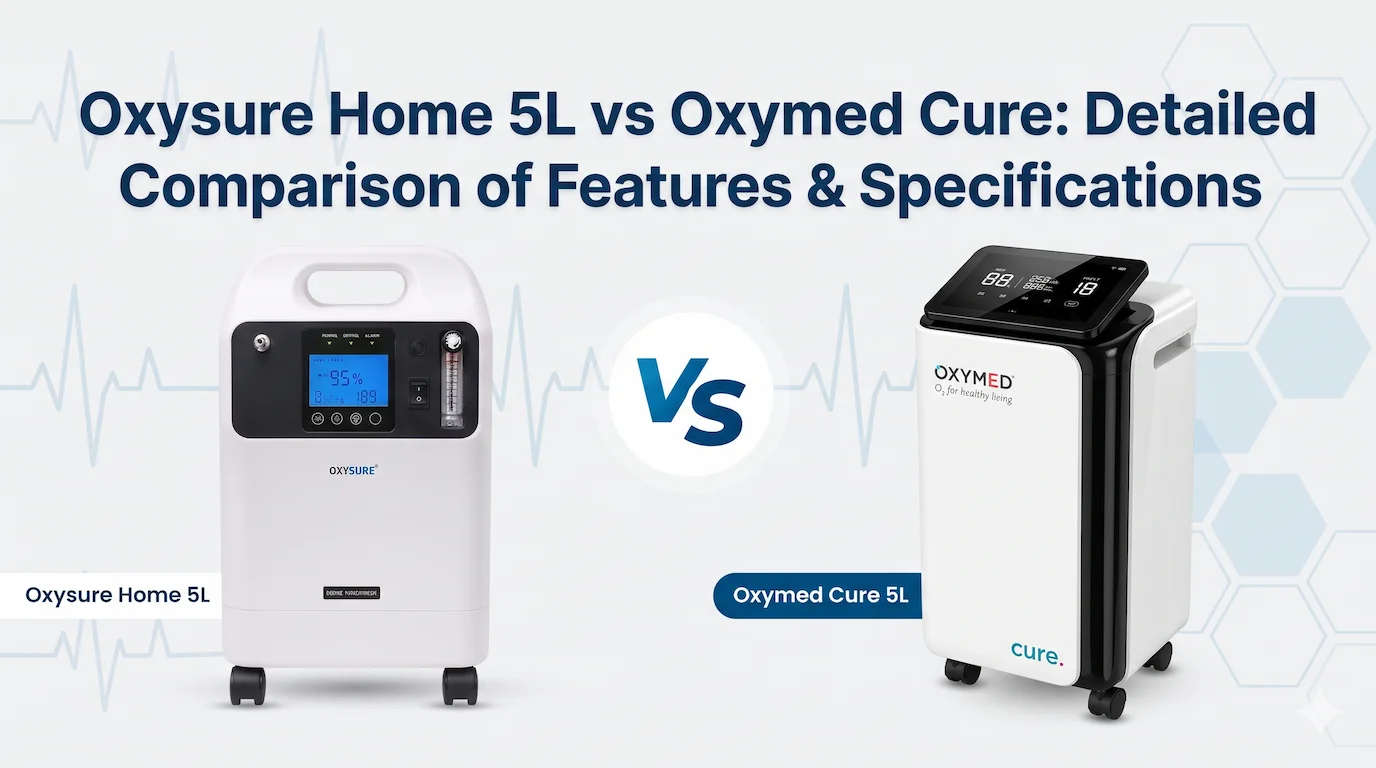
The Oxymed Cure 5 LPM and Oxysure Home 5L are two Indian-made oxygen concentrators designed for home oxygen therapy. Both deliver 93% ±3% medical-grade oxygen and offer features such as built-in nebulizers, oxygen purity monitoring, turn-off timers, and safety alarms.
Although both machines serve the same purpose, they differ in their display design, oxygen flow range, weight, sieve bed materials, and certain safety features.
In this article, we compare their specifications and practical differences to help you understand what each concentrator offers.
1. Display and Design
Both the Oxysure Home 5L and Oxymed Cure feature modern touch panels, giving them a contemporary appearance compared with traditional oxygen concentrators.
The Oxymed Cure features an 11.6-inch tilted glass touchscreen, which displays operating information and provides access to various machine functions. It also includes voice prompts to assist users during operation.
The Oxysure Home 5L features a compact touch panel with a straightforward layout. Once the machine is powered on and the required oxygen flow is set, users can start or stop oxygen delivery through its dedicated therapy control without changing their previously selected settings.
Both machines offer a modern interface, although their screen sizes and control layouts differ.
2. Oxygen Flow Range
Both concentrators provide continuous oxygen flow up to 5 LPM, but their minimum flow settings differ.
The Oxymed Cure offers a flow range of 1–5 LPM, with adjustments available in 1 LPM increments. This range is suitable for patients whose prescribed oxygen requirements match the machine's available settings.
The Oxysure Home 5L offers a wider flow range of 0.5–5 LPM, allowing lower flow settings and finer adjustments.
Many doctors prefer concentrators with a wider flow range because they provide greater flexibility for patients requiring lower oxygen flow rates.
However, if a patient's prescribed oxygen requirement falls within the available settings of Oxymed Cure, its flow range may be sufficient.
3. Floating-Ball Flowmeter
Another important difference between these two concentrators is how oxygen flow is adjusted and monitored.
The Oxymed Cure uses digital flow adjustment, where users increase or decrease oxygen flow through the + and − buttons on the control panel.
The Oxysure Home 5L uses a mechanical adjustment knob with a floating-ball flowmeter, allowing users to set the desired oxygen flow by observing the ball's position inside the calibrated tube.
A floating-ball flowmeter offers several practical benefits:
-
Precise flow adjustment: The mechanical knob allows finer adjustments between marked flow settings.
-
Direct visual indication: The floating ball provides a visible indication of the oxygen flow rate.
-
Simple operation: Users can check and adjust oxygen flow without navigating digital menus.
Both systems are designed to regulate oxygen delivery, but they offer different operating experiences.
For more information, read our article on Floating-Ball Flowmeters in Oxygen Concentrators.
4. Oxygen Purity Display and Monitoring
Both Oxysure Home 5L and Oxymed Cure deliver 93% ±3% medical-grade oxygen under their specified operating conditions.
They also feature built-in oxygen purity analyzers, allowing users to check the oxygen concentration produced by the machine.
The difference is how the oxygen purity percentage appears on the display.
Oxymed Cure
To check oxygen purity on the Oxymed Cure, users need to press the + and − buttons together. The oxygen concentration percentage then appears on the touchscreen.
This allows users to check oxygen purity whenever required.
Oxysure Home 5L
The Oxysure Home 5L displays the live oxygen purity percentage continuously on its screen.
Users can see the oxygen concentration at any time without pressing additional buttons.
Both machines provide oxygen purity information, but Oxymed Cure displays it on request, while Oxysure Home 5L keeps it visible continuously.
5. Weight and Sieve Bed Material
The Oxymed Cure weighs 18 kg, while the Oxysure Home 5L weighs 13.9 kg, making the latter approximately 4.1 kg lighter.
One factor that may contribute to this difference is the molecular sieve material used inside the machines.
Oxymed Cure: Lithium and Sodium-Based Sieve Beds
The Oxymed Cure uses a combination of lithium- and sodium-based molecular sieve materials.
Molecular sieve beds separate nitrogen from surrounding air, allowing the concentrator to produce oxygen-enriched gas.
Sodium-based molecular sieves generally have lower nitrogen adsorption efficiency than comparable lithium-based molecular sieves. Consequently, a larger quantity of material may be required to achieve similar oxygen separation performance.
Oxysure Home 5L: 100% Lithium-Based Sieve Beds
The Oxysure Home 5L uses 100% lithium-based molecular sieve beds.
Lithium-based molecular sieves generally offer higher nitrogen adsorption efficiency, allowing manufacturers to achieve the required oxygen separation using smaller quantities of sieve material.
This can contribute to a lighter and more compact concentrator.
Interestingly, higher-end models in the Oxymed range, such as the Oxymed Mini and Oxymed Intelli, also use 100% lithium-based sieve beds.
However, sieve bed material is not the only factor influencing machine weight. Compressor size, cabinet construction, cooling systems, and other internal components also contribute.
At 13.9 kg, Oxysure Home 5L is 4.1 kg lighter than Oxymed Cure, which may make it easier to move between rooms.
6. Power Consumption, Noise, and Additional Features
Both concentrators share several features that are useful for everyday home oxygen therapy.
Power Consumption
During real-world operation, both machines have recorded approximately 280 W power consumption under the referenced test conditions.
Actual electricity consumption may vary depending on operating settings and other conditions.
Noise Levels
Both machines have a stated noise level of approximately 40 dB.
Actual operating noise may vary depending on the surrounding environment and machine condition.
Built-in Nebulizer
Both Oxysure Home 5L and Oxymed Cure feature a built-in nebulizer, allowing users to perform nebulization using the supplied accessories when prescribed.
Turn-off Timer
Both machines include a turn-off timer of up to 240 minutes (4 hours).
Users can select a duration after which the machine automatically switches off.
Warranty and Service Support
Both concentrators are manufactured in India and have established service networks across the country.
Oxymed and Oxysure offer pan-India service support, making after-sales assistance accessible in many locations.
Both machines also come with a 3-year or 12,000-hour warranty, whichever occurs first.
This is a substantial warranty period for a home oxygen concentrator, although buyers should confirm the applicable terms and conditions.
7. Safety Features and Alarms
Both machines include safety alarms designed to alert users to operating problems.
Oxymed Cure
The Oxymed Cure includes alerts for:
-
Power failure
-
Low oxygen purity
-
No oxygen flow
-
Low pressure
-
System malfunction
-
Voltage-related problems
Oxysure Home 5L
The Oxysure Home 5L includes alarms for:
-
Power failure
-
Low oxygen purity
-
No oxygen flow
-
System malfunction
The Oxysure Home 5L also comes with a fire safety valve, an important accessory for home oxygen therapy.
The valve is designed to automatically interrupt oxygen flow if a fire propagates through the oxygen tubing, helping prevent the flame from travelling toward the oxygen source.
Since oxygen supports combustion, this provides an additional protective measure during oxygen therapy.
Both concentrators include safety alarms, while their supplied accessories provide different additional features.
8. What's Included in the Box?
Both oxygen concentrators come with accessories required for setting up home oxygen therapy.
Most items are similar, with a few differences.
| Accessories | Oxysure Home 5L | Oxymed Cure |
|---|---|---|
| Oxygen concentrator | Yes | Yes |
| Nasal cannula | Yes | Yes |
| Humidifier bottle | Yes | Yes |
| Humidifier connection tube | Yes | Yes |
| Nebulizer kit | Yes | Yes |
| Primary filter | Yes | Yes |
| Secondary filter | Yes | Yes |
| User manual | Yes | Yes |
| Additional cut-off filter | No | Yes |
| Fire safety valve | Yes | No |
The Oxymed Cure includes an additional cut-off filter, while the Oxysure Home 5L includes a fire safety valve.
Buyers should confirm the latest accessory package before purchasing.
9. Oxysure Home 5L vs Oxymed Cure: Specification Comparison
| Feature | Oxysure Home 5L | Oxymed Cure |
|---|---|---|
| Brand origin | India | India |
| Manufacturing | India | India |
| Oxygen purity | 93% ±3% | 93% ±3% |
| Oxygen flow range | 0.5–5 LPM | 1–5 LPM |
| Flow adjustment | Mechanical knob | Digital +/− buttons |
| Flow increment | Fine mechanical adjustment | 1 LPM |
| Control panel | Modern touch panel | 11.6-inch touchscreen |
| Floating-ball flowmeter | Yes | No |
| Oxygen purity analyzer | Yes | Yes |
| Purity percentage display | Continuously visible | On request |
| Weight | 13.9 kg | 18 kg |
| Sieve bed material | 100% lithium | Lithium + sodium |
| Real-world power consumption | Approximately 280 W | Approximately 280 W |
| Stated noise level | 40 dB | 40 dB |
| Built-in nebulizer | Yes | Yes |
| Turn-off timer | Up to 240 minutes | Up to 240 minutes |
| Warranty | 3 years / 12,000 hours | 3 years / 12,000 hours |
| Service support | Pan-India | Pan-India |
| Fire safety valve included | Yes | No |
| Additional cut-off filter | No | Yes |
Conclusion: Oxysure Home 5L vs Oxymed Cure
Both the Oxysure Home 5L and Oxymed Cure are Indian-made oxygen concentrators offering 93% ±3% medical-grade oxygen, built-in nebulizers, turn-off timers, and established service networks.
Their main differences lie in oxygen flow adjustment, purity monitoring, weight, and sieve bed materials.
The Oxymed Cure features an 11.6-inch touchscreen, voice prompts, and digital flow adjustment. The Oxysure Home 5L offers a wider flow range, a floating-ball flowmeter, continuously visible oxygen purity readings, and a lighter design.
Both machines offer practical features for home oxygen therapy. The appropriate choice depends on the patient's prescribed oxygen requirements, preferred controls, and individual home-use needs.